- Blog Categories: Construction
The construction industry in the Middle East is increasingly turning to advanced technologies to improve project productivity, reduce waste and accelerate project schedulesAmong the most significant developments remains the rise of 3D printing construction in the Middle East, which is changing how buildings and infrastructure are designed and built.
Driven by ambitious urban development programmes, sustainability targets, and the growing need for faster construction methods, governments and developers across the region are examining the potential of additive manufacturing to reinvent traditional construction practices.
From villas and offices to modular structures and experimental urban projects, the region is presenting itself as an early adopter of construction-scale 3D printing technologies.
The rise of additive manufacturing in construction
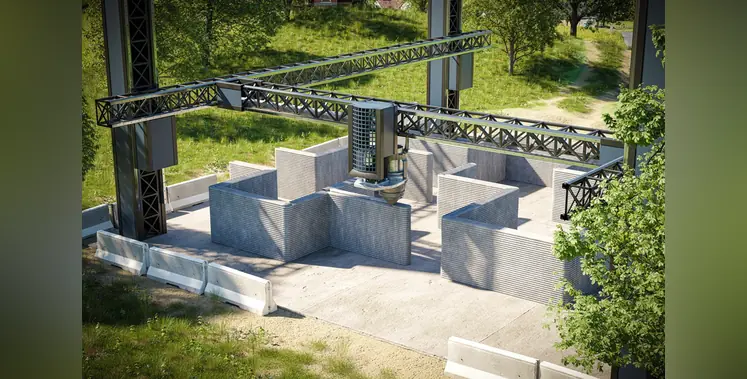
Additive manufacturing, commonly referred to as 3D printing, entails forming structures layer by layer using computer-controlled systems and specialised materials such as concrete composites. In contrast to traditional construction, which frequently depends on extensive formwork and labour-intensive processes, 3D printing automates much of the building process.
Research into construction 3D printing notes that the technology is increasingly being used for houses, bridges and even entire communities, highlighting its growing role in modern construction.
The technology is attracting attention because it can significantly reduce construction time, minimise material waste, and enable more complex architectural designs. Studies examining 3D printing in sustainable buildings also found that the technology supports customised designs, faster project delivery and sustainability-oriented construction approaches.
These advantages are particularly relevant to the Middle East, where fast urbanisation and giga-project development are increasing pressure on the construction sector to deliver projects more efficiently.
Faster project delivery and reduced labour dependency
One of the biggest advantages of 3D printing construction in the Middle East is speed.
Large-scale 3D printers can produce structural components and walls in a fraction of the time required for traditional construction methods. Industry commentary on robotic construction technologies notes that 3D-printing machines can build structures in weeks rather than months.
This accelerated timeline is helping developers reduce project delays and optimise labour requirements, particularly as construction firms face workforce shortages and rising labour costs.
Research into 3D concrete printing also highlights how the technology reduces the requirement for traditional formwork, which can account for a substantial proportion of concrete construction costs.
By automating monotonous construction processes, companies can improve productivity while reducing dependence on large onsite labour teams. This is becoming increasingly important as regional developers seek more efficient project delivery models.
Supporting sustainable construction goals
Sustainability remains another major factor driving the growth of additive manufacturing in construction.
The construction sector has traditionally been associated with high levels of material waste and carbon emissions. However, 3D printing enables far more precise material application, reducing excess consumption and minimising waste.
Research examining sustainable 3D printing applications in the UAE found that the technology supports sustainability objectives through reduced material waste, rapid construction and more economical resource use.
Construction-scale 3D printing also enables the use of alternative and locally sourced materials. Some experimental projects globally are already using earth-based materials and low-carbon alternatives to conventional concrete.
This is consistent with broader sustainable development goals across the Gulf, where governments are increasingly prioritising low-carbon construction methods and resource efficiency.
Greater design flexibility
The rise of 3D-printed buildings is also enabling architects and engineers to experiment with more complex, customised designs.
Traditional construction methods often limit design flexibility due to formwork constraints and high fabrication costs. In contrast, 3D printing enables the more efficient production of structures with curved geometries, complex facades, and unconventional forms.
Industry discussions around 3D-printed architecture in the Middle East note that large-scale printers are now capable of producing architectural-scale building elements several metres across using rapidly curing concrete mixtures.
Researchers studying additive construction also emphasise that 3D printing enables complex, optimised designs that are difficult to achieve with conventional building methods.
This is highly valuable in the Middle East, where iconic and visually distinctive architecture continues to play a central role in major urban developments.
Integration with modular construction
The growth of modular construction technology is additionally supporting the adoption of 3D printing across the region.
Modular construction involves manufacturing building components in controlled factory environments before transporting them to project sites for assembly. Industry analysis notes that modular construction is increasingly adopted due to its potential to improve quality control, reduce waste, and accelerate project completion.
3D printing complements modular approaches by supporting the rapid production of customised building components and structural elements.
The combination of digital fabrication and off-site manufacturing is helping construction companies improve operations while reducing on-site interferences and material inefficiencies. Controlled production environments also improve consistency and reduce exposure to adverse weather conditions, which can prove particularly beneficial in harsh Middle East climates.
Smart cities and future urban development
Governments across the Gulf are increasingly integrating advanced construction technologies into broader smart city strategies.
Dubai has long set itself up as a global leader in construction innovation and previously announced ambitions to become a major hub for 3D printing technologies. Parallel initiatives are emerging elsewhere in the region as governments seek to modernise infrastructure delivery and promote advanced manufacturing capabilities.
Industry experts believe the Middle East could become a global leader in robotic and additive construction technologies because of its willingness to adopt innovative building methods and invest in large-scale infrastructure programmes.
The rise of smart cities and digitally connected infrastructure is expected to further accelerate investment in automated construction systems, AI-driven design and additive manufacturing technologies.
Challenges facing adoption
Despite the momentum behind 3D printing construction in the Middle East, several difficulties remain.
Research about additive construction highlights technical limitations, material reliability concerns and quality assurance requirements as ongoing issues facing the industry.
There are also concerns surrounding structural strength, standardisation and governmental approvals for large-scale printed buildings. Some industry discussions note that while the technology offers efficiency advantages, quality control and long-term durability remain areas that require further development.
Additionally, large-scale 3D printing systems require considerable upfront investment, specialised expertise and integration with conventional construction processes.
Despite these challenges, the technology continues to advance rapidly, driven by growing investment in materials science, robotic systems, and digital construction platforms.
The future of 3D printed buildings
As construction technologies advance, the role of 3D-printed buildings is expected to expand significantly.
Advances in robotics, AI-driven design optimisation and material development are helping increase print quality, scalability and structural performance. Research suggests that additive construction could play an increasingly important role in sustainable and effective urban development.
The Middle East’s focus on innovation, sustainability, and rapid infrastructure development makes it a top candidate for the increased adoption of construction-scale additive manufacturing technologies.