Dubai's skyline has long been a canvas for unprecedented architectural ambition, continually pushing the boundaries of engineering.
A prominent trend emerging within this landscape is the fusion of high-end lifestyle brands with large-scale property development. One such groundbreaking concept taking shape in Business Bay is the advent of architectural horology, a design philosophy that translates the precision of luxury watchmaking into monumental structural forms.
A new benchmark in super-tall living
Spearheading this new benchmark for high-end living is the Burj Binghatti Jacob & Co Residences. Conceived through a high-profile collaboration between Binghatti Holdings, a leading Emirati real estate developer, and the renowned luxury watch and jewellery brand Jacob & Co, this soaring development is envisioned to become a world-first in architectural horology. Upon completion, it is set to claim the title of the world’s tallest residential building, overshadowing existing records and introducing distinctive diamond-shaped spires to the Dubai skyline.
Constructing a super-tall skyscraper of this sheer scale and complex geometric ambition requires more than standard building practices; it demands a specialist approach to formwork. To ensure speed, safety, and precision throughout the vertical construction phase, Binghatti Holdings formed a strategic alliance in 2024 with Doka, a global leader in formwork technology.
Taher Rihawi, Managing Director Doka Gulf, comments: “We value our partnership with Binghatti and are pleased to contribute our expertise to a project of this significance. The Burj Binghatti Jacob & Co Residences brings together exceptional engineering ambition and a strong local vision. We are proud to support its delivery with reliable formwork engineering and climbing solutions, and we look forward to continuing our close collaboration throughout the construction process.”
Advanced climbing solutions for rapid progress
To meet the intense structural demands of a high-rise project aiming for a rapid cycle of one floor per week, the construction methodology heavily relies on advanced vertical and horizontal solutions. A comprehensive suite of engineering equipment is being deployed to maintain this pace independent of crane availability.
The project's key technical and construction specifications include:
Automatic climbing systems: The SKE50 plus system allows the building’s core and shear walls to rise sequentially, optimising the weekly floor cycle without relying on tower cranes.
Enhanced site operations: A self-climbing platform provides essential additional working levels, empowering construction teams to coordinate multiple complex activities safely in parallel.
Slab construction efficiency: The lightweight Dokadek 30 system is utilised to guarantee rapid assembly times and a consistent structural quality across the floor plates.
Comprehensive edge safety: Doka’s Protection screen Xclimb 60 entirely encloses the active work areas, creating a highly secure environment at the slab edges.
Integrated materials handling: A flexible table lifting system (TLS) climbs hydraulically alongside the platform system, greatly easing the physical handling of materials across all active zones.
Façade installation protection: For the final stages, additional tailored protection screens will safeguard crews working at extreme heights right to the very top.
Integrating global engineering with local delivery
Delivering a project of this magnitude requires seamless integration between global engineering knowledge and on-the-ground execution. Behind the scenes, structural progress is the result of highly coordinated efforts between engineering teams based at Doka’s Austrian headquarters and their local counterparts in Dubai. This dual approach was critical in ensuring timely design deliverables and facilitating the local fabrication of specifically selected system components, thereby significantly reducing lead times.
On the construction site, these engineers work hand in hand with the main contractor, Granada Europe Engineering Contractions LLC, guaranteeing that assembly, logistics, and safety protocols adhere to the highest international standards. The main construction period is scheduled to run continuously between 2024 and 2026, with the final completion targeted for the end of 2027.
By contributing to the Burj Binghatti Jacob & Co Residences, the engineering teams are reinforcing a long-standing legacy in the region's most iconic super-tall structures. From historic involvement in the Burj Khalifa to upcoming plans for the Burj Azizi—planned to be the second-tallest tower worldwide—the focus remains firmly on shaping the next generation of monumental high-rise developments.
Pushing the limits of Dubai's skyline with architectural horology
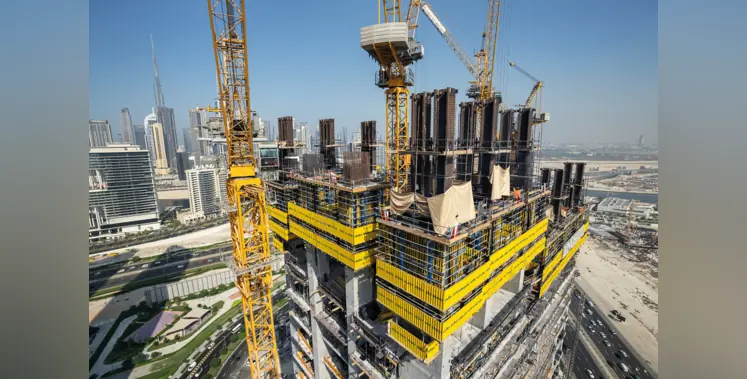
Upon completion, it is set to claim the title of the world’s tallest residential building, overshadowing existing records and introducing distinctive diamond-shaped spires to the Dubai skyline.