As industry leaders and policymakers gathered for the recent London Climate Action Week, the urgency to protect global infrastructure from climate-related threats took centre stage.
Amidst this crucial dialogue, Bentley Systems, the infrastructure engineering software company, shared vital findings from a commissioned study conducted by the independent research firm Verdantix. The comprehensive report, titled Beyond Reactive: How Digital Intelligence Is Enabling Infrastructure Resilience for a Climate-Disrupted World, exposes a significant execution gap between the strategic resilience goals of the infrastructure sector and its practical ability to operationalise them.
The study draws on detailed insights from senior executives across large-scale energy, mining, transportation, and water organisations worldwide. It highlights that infrastructure resilience is unequivocally recognised as a top strategic priority. Impressively, more than 80% of the surveyed infrastructure organisations report having mature or developing resilience strategies. However, despite this strong commitment, translating strategy into tangible action remains a formidable challenge. The primary culprits hindering progress are persistent technology and data limitations. More than two-thirds of the respondents cited fragmented data and disconnected digital systems as their top two technical barriers to improving resilience. This digital fragmentation severely limits visibility across complex assets, interconnected networks, and climate-related risks, directly preventing organisations from developing a unified operational view.
Amit Prothi, Director General of the Coalition for Disaster Resilient Infrastructure (CDRI), who authored the foreword for the report, underscored this critical transition. He stated: "As climate-driven disruptions become more frequent and interconnected, infrastructure resilience must move from policy ambition to operational reality. Investments in risk-informed planning, data systems, and digital capabilities can significantly reduce the cascading impacts of infrastructure disruptions. Building resilience requires a system-wide approach."
Overcoming Barriers with Digital Intelligence
The Verdantix research indicates that more than 70% of organisations plan to increase their spending on digital twins over the next 24 months. Simultaneously, AI is already delivering measurable value across the sector. Currently, half of the respondents utilise AI for routine infrastructure inspections, and more than 40% have implemented AI-powered failure prediction capabilities. This robust technology adoption signals a decisive industry shift away from reactive maintenance and toward sophisticated predictive operations.
Adding essential context to these empirical findings, Priyanka Bawa, Principal Analyst at Verdantix, explained the core issue facing operators: "The research highlights a fundamental operational challenge. While most organisations have a resilience strategy in place, their digital systems are rarely integrated enough to execute it. When critical information remains siloed, infrastructure owners cannot accurately assess complex network vulnerabilities or demonstrate the clear return on investment necessary to secure future funding."
Moving Beyond Reactive Operations
The report highlights the pressing need for infrastructure owners to move beyond monitoring individual, isolated assets. Instead, they must pivot toward the holistic management of interconnected systems and networks. To effectively support this transition, open digital twins serve as a critical enabler. These advanced platforms uniquely bring together operational, environmental, and risk data, vastly improving visibility and generating the predictive insights necessary to proactively reduce infrastructure vulnerabilities against environmental threats.
Speaking during a prominent panel discussion at London Climate Action Week, Chris Bradshaw, Bentley’s Chief Sustainability and Education Officer, noted: "Infrastructure professionals already collect much of the data needed to understand climate-related risks. The biggest barrier is fragmentation. Open digital twins help address this challenge by bringing disparate data sources into a single, accessible environ ment. This integration enables engineering teams to move from reactive maintenance toward predictive insights and more proactive, long-term resilience planning.
AI and Digital Twins accelerate infrastructure resilience
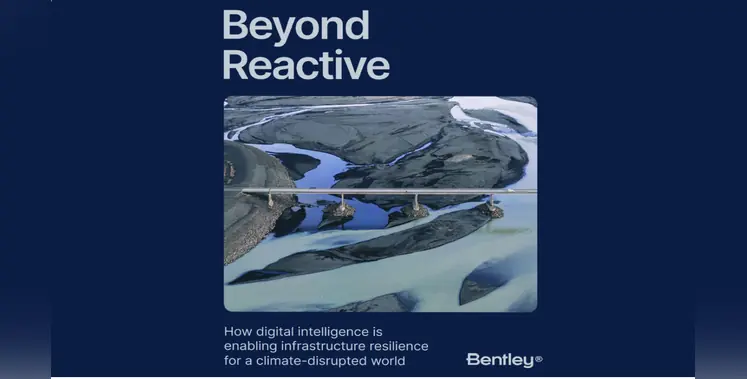
Bentley Systems, the infrastructure engineering software company, shared vital findings from a commissioned study conducted by the independent research firm Verdantix.