The escalating global water crisis represents one of the most profound threats to international stability, public health, and sustained economic development.
As climate change exacerbates resource scarcity, the need for immediate, coordinated intervention has never been more urgent. Confronting this global challenge head-on, the Kingdom of Saudi Arabia and the Republic of Senegal, in collaboration with the Global Water Organisation (GWO), recently convened a critical high-level ministerial dialogue.
Held on the sidelines of the 81st session of the United Nations General Assembly (UNGA) in New York, the event, titled “United for Water: A Call for Collective Action”, brought together a diverse coalition of leaders. Ministers, senior government officials, representatives from multilateral development banks, United Nations agencies, and water sector pioneers gathered at the United Nations Headquarters. Their shared objective was clear: to evaluate the growing pressures on global water resources and outline practical pathways to secure a water-resilient future.
The Imperative for Global Cooperation
Water security is no longer a peripheral environmental issue; it is the fundamental bedrock of societal resilience. The UNGA dialogue underscored how water access intersects with every facet of human survival, from food security and robust public health to climate adaptation and economic continuity. During the opening session, high-level political commitment was demonstrated through remarks from the Deputy Minister of Foreign Affairs for International Multilateral Affairs of Saudi Arabia and the High Representative of the President of the Republic of Senegal, supplemented by a special address from the UN Special Envoy on Water.
Emphasising the necessity of a unified approach, H.E. Dr. Fahad Balghunaim, Head of the GWO Founding Team, articulated the core mission of the assembly:
“Water underpins public health, food security, economic development, climate resilience and stability. Your presence here reflects the importance the international community places on water, and we must now translate that commitment into tangible results. This means aligning financing with credible priorities, accelerating high-impact innovation, strengthening access to reliable data and building institutional capacity for implementation. Collective action asks each of us to bring our strongest capabilities to a purpose we hold in common.”
Translating Dialogue into Tangible Results
A major theme of the UNGA side event was the urgent need to transition from diplomatic discourse to measurable, on-the-ground implementation. Participants actively exchanged national experiences, highlighting how governments and international institutions can forge scalable partnerships to deliver practical solutions.
To achieve these ambitious targets, the dialogue focused on several critical implementation strategies:
Mobilising Sustainable Financing: Identifying new funding mechanisms and aligning global capital with priority water infrastructure projects.
Fostering High-Impact Innovation: Developing and deploying advanced technologies to optimise water management, conservation, and distribution.
Enhancing Data Accessibility: Strengthening the collection and sharing of reliable data to inform evidence-based policy and governance.
Building Institutional Capacity: Equipping local and national bodies with the expertise required for practical delivery at scale.
By strengthening the connections between governments, development partners, and key stakeholders, the international community aims to create robust frameworks that support water security and broader sustainable development goals.
A Permanent Framework: The Global Water Organisation
Central to these international efforts is the Global Water Organisation. Envisioned as a permanent institutional mechanism dedicated exclusively to global water cooperation, the GWO serves as a collaborative platform connecting countries with the expertise, financing, and partnerships necessary to achieve their objectives.
First announced in September 2023 by His Royal Highness Prince Mohammed bin Salman bin Abdulaziz Al Saud, Crown Prince and Prime Minister of Saudi Arabia, the organisation has rapidly solidified its position. In May 2025, the GWO’s Charter was officially signed in Riyadh—which serves as its headquarters—by eight founding Member States: Greece, Kuwait, Mauritania, Pakistan, Qatar, Saudi Arabia, Senegal, and Spain.
Guided by its foundational vision, “United for Water”, the GWO operates across four strategic pillars to empower governments and institutions worldwide:
Facilitating Financing and Funding: Streamlining investment into critical water infrastructure and sustainable resource programmes.
Data Insights and Reporting: Providing accurate, comprehensive analytics to guide international water policy.
Research and Innovation: Driving forward-thinking solutions to overcome complex water scarcity challenges.
Policy and Governance: Assisting Member States in developing robust frameworks for effective water management.
As global water demands continue to rise, the collaborative efforts championed at the UNGA highlight a decisive shift in international diplomacy. By leveraging the structured support of the GWO, nations are better equipped to coordinate their capabilities and ensure a stable, water-secure future for generations to come.
Global water security: UNGA sparks collective action
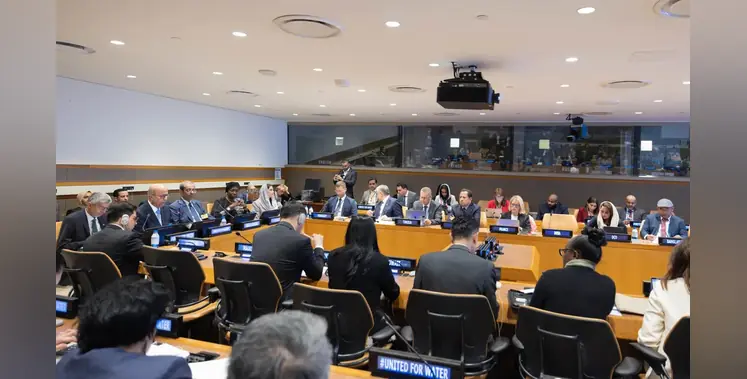
The Kingdom of Saudi Arabia and the Republic of Senegal, in collaboration with the Global Water Organisation (GWO), recently convened a critical high-level ministerial dialogue.