The robotics landscape is experiencing an unprecedented evolution.
Driven by rapid advancements in physical artificial intelligence (AI), the global market for humanoid robots is expanding at a staggering pace. In the first half of 2026 alone, global shipments of humanoid robots surged by 300 per cent year-on-year, reaching more than 22,000 units. According to industry data from Counterpoint Research, this remarkable trajectory is expected to push total shipments beyond 50,000 units by the end of the year.
This exponential growth reflects a fundamental shift in how modern enterprises approach automation. We are moving beyond stationary machinery towards embodied AI—machines that can perceive, reason, and act dynamically within the physical world.
Transforming industries with intelligent machines
From complex manufacturing to healthcare, logistics, and hospitality, physical AI is reshaping operational efficiency. Intelligent machines are increasingly capable of undertaking demanding industrial tasks, acting as multilingual assistants, and integrating with wearable exoskeletons to enhance human capabilities across diverse sectors.
Key technological developments in this sector are driving the deployment of robotic workforces across the globe. Several major innovations define the current commercial market:
Industrial application: Companies like UBTECH are successfully deploying humanoids in car factories, with units currently undergoing rigorous testing by major aerospace manufacturers such as Airbus.
Heavy-duty operations: Lumos Robotics has developed the MOS 2, a wheeled ‘AI Worker’ equipped with dual arms. Capable of handling payloads of up to 50 kg, the first-generation MOS models recently completed over 1,000 hours of continuous, failure-free operation performing material handling and quality inspection at Mitsubishi Electric’s Changshu factory.
Advanced mobility: Firms such as DEEP Robotics are pioneering quadruped technology, while others focus on dynamic bipedal movement. For instance, the NIX S3 robot demonstrates exceptional agility with 21 degrees of freedom and high-torque joints.
Advancing urban infrastructure through automation
Beyond the factory floor, advanced robotics are rapidly becoming a cornerstone of smart city infrastructure. Dubai serves as a prime example of this transition, aggressively advancing its ambitions through a dedicated Robotics and Automation Programme. The emirate has set a decisive target to deploy 200,000 robots over a ten-year period leading up to 2032.
This urban integration includes highly specialised deployments designed to enhance public services, safety, and everyday convenience:
Public security: The UAE’s Micropolis Robotics provides autonomous patrol robots specifically designed to support the Dubai Police in maintaining safe urban environments.
Commercial interaction: Innovations like the TP01 humanoid, developed by the Chengdu Humanoid Robot Innovation Centre’s Raydiculous brand, are built for public services and can seamlessly communicate in both English and Arabic.
Service solutions: UAE-based integration specialists, including Mangobot and Lootah Robotics, are delivering comprehensive robotic workforces that encompass autonomous general-purpose units, cleaning machines, and multilingual receptionists.
Driving innovation at the world's largest tech showcase
The convergence of these groundbreaking technologies will be prominently featured at GITEX World RobotiX, a new launch event taking place at the Dubai Exhibition Centre, Expo City Dubai, from 8 to 11 December 2026. As part of the 46th edition of GITEX GLOBAL—organised by inD—the showcase will highlight the commercialisation of embodied AI.
The exhibition will host an array of global pioneers. Unitree, which commands a 31 per cent share of the global humanoid market, will spearhead the participation alongside automotive AI brands like AiMOGA and consumer developers such as Light Origins, debuting an interactive ‘bunny-shaped’ household robot.
The event also places a strong emphasis on foundational computing hardware. Chinese developer JWIPC will launch advanced robotic controllers built on NVIDIA’s Thor module, delivering up to 2,070 TFLOPS of FP4 computing performance for real-time decision-making. Simultaneously, software developers like Songying Technology are streamlining AI training through simulation environments like ORCA OS.
To support future talent, the UAE-based education firm Besomi will introduce the ‘Besomi Rangers’ at a live Robotics and AI Lab. Supported by industry giants like Qualcomm and Seeed Studio, this initiative provides hands-on engineering training using the Arduino VENTUNO platform for the innovators shaping the physical AI revolution.
Global humanoid robot shipments jump 300% in 2026
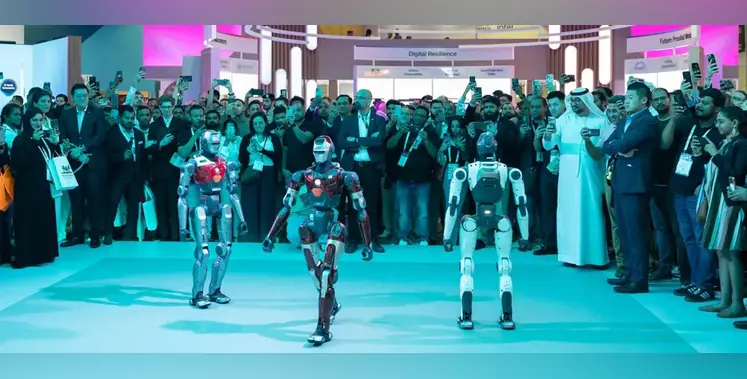
The convergence of these groundbreaking technologies will be prominently featured at GITEX World RobotiX, a new launch event taking place at the Dubai Exhibition Centre, Expo City Dubai, from 8 to 11 December 2026.