A look at Dubai’s first fully underground gold line metro
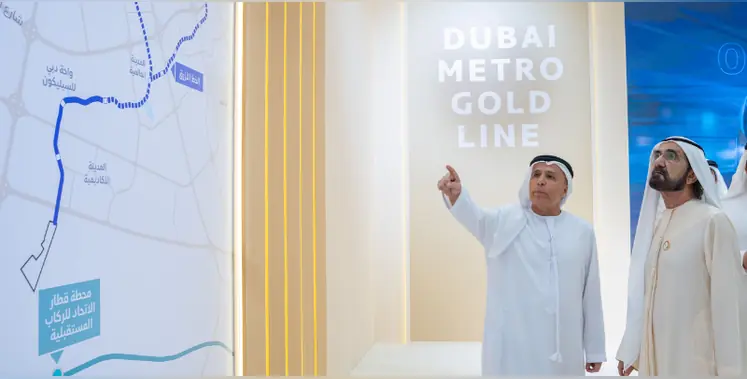
Dubai has announced its most ambitious metro expansion to date with the launch of the Gold Line, a fully underground route that promises to reshape urban mobility across the emirate.
The Dh34 billion project, approved by His Highness Sheikh Mohammed bin Rashid Al Maktoum, Vice President and Prime Minister of the UAE and Ruler of Dubai, represents a significant leap in infrastructure development.
Spanning 42 km and running entirely at a depth of up to 40 m, the Gold Line will be Dubai’s first fully subterranean metro line, marking a departure from the elevated and partially underground designs of the existing Red and Green lines.
Joseph Salem, partner and head of the travel, transportation & hospitality practice at Arthur D. Little Middle East, described the project as “a landmark moment in the emirate’s infrastructure evolution, and arguably the most ambitious urban transport undertaking in the Middle East in a generation.”
He highlighted the engineering challenges and innovations involved, noting that the decision to construct the line entirely underground reflects the maturity of Dubai’s urban fabric and the need to route a major transit artery through dense commercial and residential districts without causing surface disruption.
Utilising the latest tunnel boring machine technology, the Gold Line will pass beneath Dubai Creek and some of the city’s busiest business corridors.
This approach sets a new regional benchmark for underground rail delivery while minimising disruption to daily life and existing infrastructure.The route has been meticulously planned as a genuine urban connector, featuring 18 stations across 15 strategic locations.
It begins at the historic Al Ghubaiba waterfront and threads through areas including City Walk, Business Bay, Mohammed Bin Rashid City, Meydan, Nad Al Sheba, Al Barsha South, and Jumeirah Village Circle, before terminating at Jumeirah Golf Estates.
This alignment directly serves corridors home to 55 mega-development projects currently under construction, addressing long-standing mobility infrastructure deficits in these high-growth zones.
Upon completion, the line is expected to benefit more than 1.5 million residents.
From an intermodal perspective, the Gold Line will integrate seamlessly with the existing Red and Green Metro lines at multiple interchange points.
It will also connect to Etihad Rail at Meydan and Jumeirah Golf Estates, transforming it from a purely city metro into a vital component of a broader national transport network.
This linkage will, for the first time, connect Dubai’s urban core to the wider UAE rail ecosystem, enhancing regional connectivity.
Economically, the project is projected to deliver substantial returns.
Authorities anticipate a daily ridership of 465,000 passengers beyond 2040, with the Dh34 billion investment expected to generate a 430% cumulative economic return over 20 years.
These benefits will stem from time and fuel savings, reduced road accidents, and lower carbon emissions.
The Gold Line is scheduled for inauguration on 9 September 2032 (exactly 23 years after the original Dubai Metro launch in 2009) and is being delivered on a timeline 30% faster than the Blue Line.
Salem emphasised that the Gold Line is as much an economic infrastructure project as a transport one.
By alleviating congestion and supporting sustainable growth, it will reinforce Dubai’s position as a global leader in smart, future-ready urban mobility.
Tenders are expected to be issued later this year, with contract awards anticipated in 2027 and construction commencing shortly thereafter.