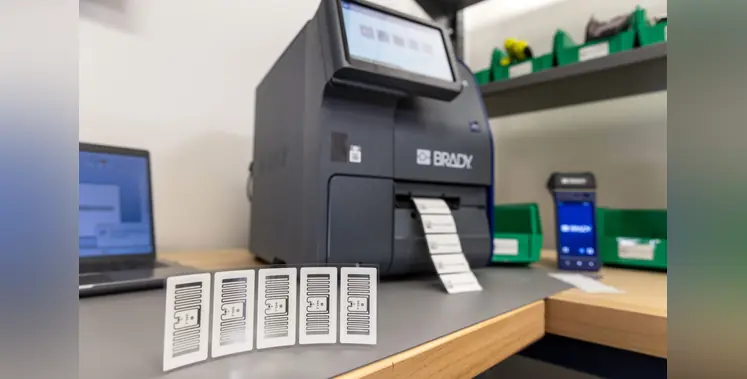
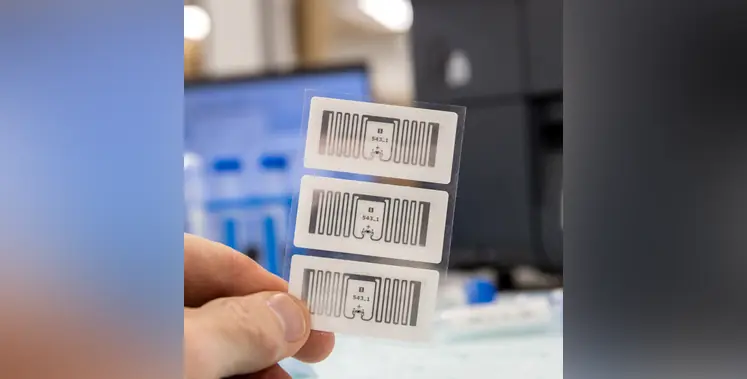
The integration of smart technologies, such as digital passports and automated inventory systems, requires robust labelling infrastructure.
Addressing this industry-wide need for sustainable and highly reliable printing, Brady Corporation has introduced the new i7500 RFID label printer, a device designed to eliminate consumable waste and streamline on-premise RFID encoding.
Eliminating consumable waste in calibration
Competitive printer models frequently waste between 10 and 30 labels following each consumable change during the calibration phase. This not only drives up material costs but also generates unnecessary industrial waste. The newly launched BradyPrinter i7500 Industrial RFID Label Printer addresses this challenge by ensuring that the very first RFID label is printed and encoded correctly, resulting in strictly zero label waste during the calibration process.
This technology limits the production of void labels and prevents significant time loss in demanding production environments. By eliminating calibration waste, the system offers an environmentally conscious and highly practical solution, particularly for users who may not be RFID technology experts.
Patent-pending technology and automated setup
One of the most complex aspects of industrial labelling is managing different tag types and specifications. Most conventional RFID printers require users to manually input data to locate chips and set parameters. In contrast, the i7500 RFID printer features patent-pending print and encoding technologies that automatically locate the RFID chips within the loaded labels.
Automatic Optimisation: The device autonomously selects the correct internal antenna and optimal power level required to encode the specific UHF RFID labels currently loaded into the system.
Precision Recognition: The automated technology accurately recognises RFID chips even on extremely small labels, operating effectively on widths as narrow as 15 mm.
Rapid Changeovers: The automated setup process for diverse label types—including large, small, off-metal, and on-metal UHF RFID labels (up to 2mm thick), can be completed in under three minutes.
This material setup speed makes the printer 25 to 2 times faster than most competitive models on the market. The device actively protects industrial operational throughput, operating at a print and encode speed of just three seconds per label. It is designed to keep production lines moving, significantly reduces unplanned downtime, limits support interventions and prevents component scrap and production bottlenecks.
High accuracy data and global standards
The i7500 RFID printer includes a built-in automated UHF RFID label encoding verification system, ensuring high accuracy across everything from small component tags to large pallet labels. Beyond standard encoding, the printer supports versatile legacy applications by simultaneously adding human-legible text alongside tiny machine-readable barcodes and QR-codes, available in crisp 300 and 600 dpi resolutions.
For seamless operational integration, data can be directly sourced from internal company systems and transmitted to the printer via multiple connectivity options, including:
Ethernet
USB
Wi-Fi
Bluetooth
Also, the device fully supports common global data standards, allowing users to print and encode item-level barcodes and GS1 standards for worldwide unique RFID EPC codes.
Next-level track and trace connectivity
This printer is a foundational element for next-generation facility management, bringing on-premise RFID printing to a wider range of industries. By giving any asset, item, or product a unique digital identity that can be read from a distance without a direct line of sight, organisations can completely overhaul their operational tracking.
When integrated into a broader workflow, the encoded labels can trigger Internet of Things (IoT) events and automations upon being scanned, whether individually or in specific volume batches. This unlocks the ability to enable home-in applications on tagged assets, drastically improve just-in-time tracking, and strengthen overall supply chain compliance. Products can also be directly linked to their digital passports using RFID technology.
Forming part of a complete industrial RFID solution that includes reliable labels, software, and RFID readers, the BradyPrinter i7500 RFID delivers quality traceability for any industry seeking to modernise their operations.
Brady Corporation leads zero-waste RFID label printing
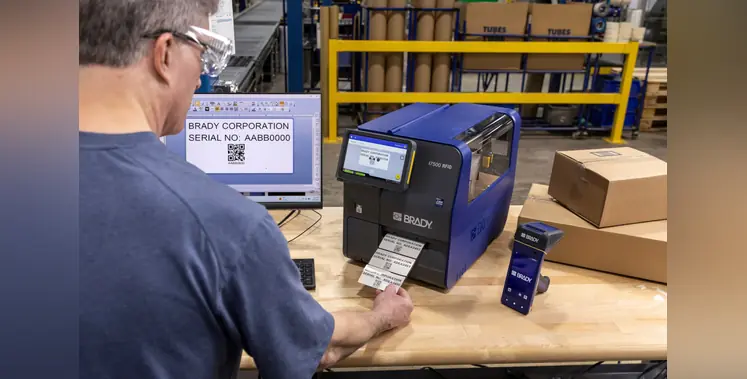
Brady Corporation has introduced the new i7500 RFID label printer, a device designed to eliminate consumable waste and streamline on-premise RFID encoding.