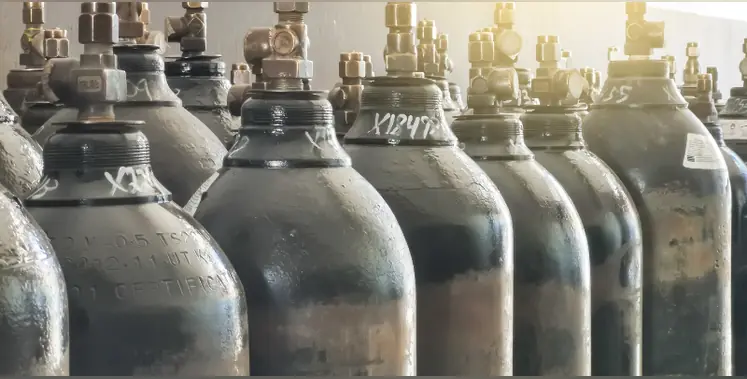
Helium, a scarce non-renewable gas, is indispensable for numerous high-tech sectors with few viable substitutes.
Its unique cryogenic properties, superior heat conduction, chemical stability, tiny atomic size, and rapid diffusion make it vital in semiconductor fabrication, medical MRI scanners, aerospace, fibre optics, and advanced research.
The ongoing conflict in the Middle East, including attacks on Qatar’s key energy infrastructure and the effective closure of the Strait of Hormuz, has severely disrupted not only oil and gas flows but also global helium availability.
Qatar, home to the massive Ras Laffan facility, normally accounts for over a third of worldwide helium supply as a by-product of large-scale natural gas processing.
Damage to the site and blocked shipping routes have created a dual shock, driving up prices and threatening downstream industries.
In semiconductor manufacturing, helium plays multiple irreplaceable roles.
It serves as a carrier gas in deposition, a diluent in plasma etching, and a coolant to prevent wafer warping during high-temperature steps.
It is particularly critical for extreme ultraviolet (EUV) lithography used in sub-5nm chips that power artificial intelligence and high-performance computing. The gas also enables leak detection and maintains ultra-pure environments in fabrication plants.
Some experts noted that semiconductor fabs are reliant on a stable supply, highlighting that helium escapes storage containers at roughly 1% per day, making large inventories impractical.
Demand for helium in chip production is forecast to rise more than fivefold by 2035, according to market analysts.
Major players such as TSMC typically hold several months of stock and operate recycling systems, yet prolonged disruption could slow output or, in extreme cases, force temporary shutdowns.
South Korea’s chipmakers, including Samsung and SK Hynix, appear especially exposed after sourcing around 65% of their helium from Qatar in recent years, though some have secured longer-term deals with suppliers drawing from US sources.
Taiwan has a somewhat more diversified position but still faces risks.
Helium is typically extracted in tiny concentrations (0.3–0.5%) from natural gas and requires energy-intensive cryogenic separation, membranes, and pressure swing adsorption before liquefaction for transport.
Qatar’s vast processing scale at Ras Laffan made it uniquely central to global supply.
Alternative geological sources with higher helium concentrations exist, notably in the US and Canada, where smaller operators can deploy lower-cost membrane and PSA technologies, but scaling these will take time.
Some industry figures have estimated that if the strait opened immediately, it would still take four to six months to normalise supply.
Should the crisis persist, semiconductor manufacturers are likely to accelerate helium reclamation and conservation techniques, similar to closed-loop systems successfully adopted in modern MRI machines.
Past shortages over the last two decades have already encouraged diversification strategies, including broader sourcing from the US, Russia, and emerging projects.
While contingency plans exist, the duration of the current blockage will determine the full extent of impact on the chip sector and the wider technology supply chain.
Persistent volatility could hasten efforts to reduce single-country dependence and promote balanced global helium sourcing.
This report was based on insights from IDTechEx
Helium supply crisis hits semiconductor industry amid Hormuz blockade