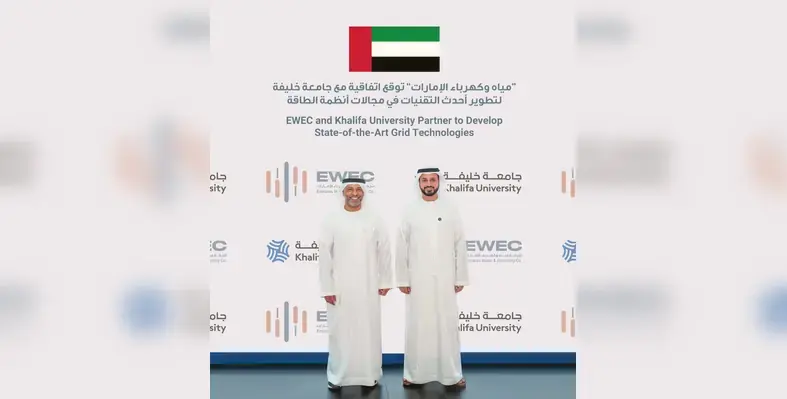
Emirates Water and Electricity Company (EWEC) has signed an agreement with Khalifa University of Science and Technology to jointly develop advanced energy system tools aimed at strengthening the stability and resilience of the UAE’s rapidly decarbonising power sector.
The collaboration will focus on developing intelligent, software-based solutions to support grid stability as renewable energy penetration accelerates across Abu Dhabi and the wider UAE. The initiative comes as EWEC advances a major transformation of the water and power sector, targeting nearly emissions-free water production by 2030 and meeting 60 per cent of Abu Dhabi’s electricity demand from renewable and clean energy sources.
EWEC’s strategy includes the large-scale rollout of utility-scale solar photovoltaic (PV) capacity, forecast to exceed 30GW by 2035, alongside 8GW of battery energy storage systems. The transition is further supported by the decoupling of water and power production through low-carbon reverse osmosis desalination.
As variable renewable energy sources become increasingly integrated into the grid, managing system stability has become a critical priority. Under the agreement, EWEC and Khalifa University will develop intelligent software modules to support the integration of large-scale PV generation and energy storage into the power system. These tools will include predictive modules to forecast power ramping requirements, providing advisory support to operators to ensure secure operation within system limits.
The partnership will also deliver machine learning-based tools to estimate system inertia and forecast frequency deviations, alongside recommendations to mitigate potential grid stability risks.
Ahmed Ali Alshamsi, Chief Executive Officer of EWEC, said the collaboration supports EWEC’s broader role in shaping the UAE’s energy future through strategic planning and the deployment of large-scale solar and battery assets, while accelerating the transition to near-zero-emission water production via reverse osmosis. He added that integrating advanced analytics and AI-driven forecasting into operations will help build a future-ready water and power sector and support progress towards the UAE Net Zero by 2050 Strategic Initiative.
His Excellency Professor Ebrahim Al Hajri, President of Khalifa University, said the partnership demonstrates the role of academia in addressing real-world energy challenges and positions the university at the intersection of innovation and national strategy. He noted that the collaboration will harness advanced deep learning and intelligent modelling to support resilient, data-driven power systems, while transferring knowledge to the next generation of Emirati engineers and system operators.
Beyond technical development, the partnership includes a structured knowledge-transfer programme comprising technical documentation, training and a multi-day operational workshop. Emirati participation is embedded within the project team, with monthly reporting on skills transfer and national capacity-building outcomes.
The initiative aligns with EWEC’s long-term strategy to deliver a smarter, cleaner and more resilient energy system, combining advanced analytics with world-class infrastructure to ensure grid stability, accelerate decarbonisation and strengthen national capabilities.
EWEC and Khalifa University partner on grid stability tools