The transition towards zero-emission commercial transport is gathering immense momentum, yet a formidable obstacle remains firmly in its path: inadequate grid capacity.
As operators modernise their fleets with heavy-duty electric vehicles, the demand for fast charging frequently outstrips the physical capabilities of local electrical infrastructure. Lengthy municipal permitting processes, substantial civil works, and overloaded fixed connections often stall critical deployment timelines.
Addressing this infrastructural bottleneck, Volvo Penta has stepped forward with a flexible approach. At IAA Transportation 2026 in Hannover, Germany, the organisation is demonstrating how mobile battery energy storage can bridge this widening gap, delivering reliable power exactly where and when it is needed most.
The Urgent Need for Flexible Charging Solutions
The move to fully electrified transport networks cannot wait for permanent grid upgrades. Transport companies frequently operate in temporary locations or remote hubs where installing permanent charging infrastructure is either financially unviable or logistically impossible. Even in established urban logistics centres, high-power electric vehicle charging during peak demand periods can easily overwhelm local grid connections.
By deploying mobile battery-powered charging units, commercial operators bypass these significant delays. A mobile Battery Energy Storage System (BESS) acts as a strategic buffer. It slowly draws power from a constrained grid connection or intermittent renewable energy source, storing that energy to discharge it at high rates for rapid vehicle charging.
Enter the Mobile BESS Subsystem
Volvo Penta is exhibiting alongside fellow Volvo Group company, Volvo Trucks. Taking centre stage is the company's adaptable BESS subsystem, built directly upon battery technology successfully deployed in Volvo Group’s demanding on-highway and off-highway vehicles. Engineered for the rigorous demands of continuous heavy-duty utilisation, this subsystem provides a robust foundation for off-grid power.
It mitigates the transport electrification bottleneck through several technical advantages:
- High Energy Density: The battery pack stores maximum power within a compact, modular footprint.
- Favourable C-rate: Optimised for rapid charging and discharging, ensuring vehicles spend less time plugged in.
- Automotive-Grade Resilience: Managed by a sophisticated system that continuously monitors operational performance.
- Enhanced Cybersecurity: The robust architecture safeguards critical energy data from unauthorised interference.
- Maximised Longevity: Intelligent cell management prevents excessive degradation during high-intensity charging cycles.
This setup provides immediate charging capacity for unexpected disruptions. In fixed installations, it can boost limited grid connections, successfully supporting high-power charging even when demand is exceptionally high.
“Reliable power infrastructure is critical to the transition toward zero-emission transport,” said Tommi Wulff, Sales and Business Development Manager at Volvo Penta. “Battery energy storage can help bring fast charging to locations where grid capacity is limited or permanent infrastructure is not yet in place. At IAA Transportation, we are showing how Volvo Penta can support this transition by providing a proven, scalable BESS subsystem that our partners can build into complete charging and energy storage systems.”
A Collaborative Blueprint for Electrification
Volvo Penta’s core strategy is centred around collaboration. By supplying its proven battery technology alongside extensive application expertise, the organisation provides specialist partners with a robust platform to develop complete, field-ready energy storage solutions. This partnership model is essential for tailoring technology to specific markets and operating environments. A prime example showcased alongside the subsystem is the Hivolt 380X, a complete, ready-to-deploy mobile unit developed by system integrator Contour Advanced Systems.
“Volvo Penta’s BESS subsystem gives us a proven battery foundation for the Hivolt 380X,” said Jacco Lemmen, Business Development Manager at Contour Advanced Systems. “By combining Volvo Penta’s technology with our system integration and manufacturing expertise, we are showcasing a solution designed and made in Europe, with European components and software, and built around shared values of safety, quality and cooperation.”
Accelerating the Zero-Emission Future
Solving the charging challenge requires more than just advanced vehicles; it requires deployable energy networks that adapt to real-world limitations. The partnership between Volvo Penta and Contour Advanced Systems illustrates a highly practical pathway forward for the transport sector.
Volvo Penta is exhibiting at IAA Transportation 2026 in Hannover, Germany, from September 15–20, in Hall 11, Stand F31.
Volvo Penta solves the fast-charging bottleneck
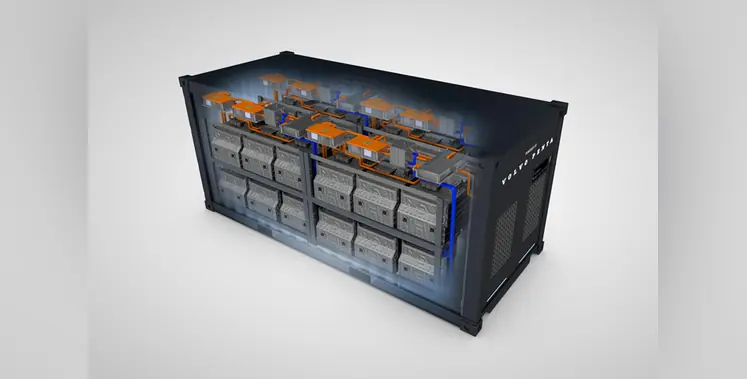
Volvo Penta has stepped forward with a flexible approach. At IAA Transportation 2026 in Hannover, Germany, the organisation is demonstrating how mobile battery energy storage can bridge this widening gap.