The report Rise of Renewables in the Gulf Region, unveiled at the World Future Energy Summit, forecasts a dramatic expansion of variable renewable energy across the Middle East and North Africa (MENA), projecting capacity to grow roughly tenfold by 2040 and continue rising through 2060.
The study emphasises that this growth will occur even as the region maintains its position as a major oil and gas producer.
According to the analysis, renewable energy is set to become a central component of MENA’s electricity system. By 2060, electricity is expected to represent around 35% of the region’s total energy demand, with most of it sourced from renewables. Solar and wind are projected to account for roughly 85% of electricity generation, with solar contributing about 45% and wind approximately 40%.
“The rapid rise of renewables in the Gulf, and MENA more broadly, is not replacing hydrocarbons overnight, but it is reshaping the power system,” said Ditlev Engel, Energy Systems CEO at DNV. “GCC countries are building some of the world’s largest solar and storage projects while still supplying global oil and gas markets. This development is driven mainly by economics. Renewables now provide low-cost electricity, and clean power is becoming necessary for competitive industry and future hydrogen production.”
DNV notes that this shift is being driven by both growing renewable supply and increasing electricity demand. Across the region, large-scale projects—including mega solar farms, hybrid solar-and-storage plants, and wind installations—are under development. Demand is rising due to data centres, electric transport, and green hydrogen initiatives, while traditional industries are moving toward low-carbon electricity in response to policy measures such as the EU’s Carbon Border Adjustment Mechanism.
The report identifies 2040 as a turning point when renewable generation growth is expected to outpace total electricity demand, boosting the share of clean energy in the regional mix.
Solar energy remains dominant, with installed capacity projected to rise from 76GW in 2024 to 340GW by 2029, supplying nearly one-fifth of electricity by decade’s end. Battery storage will increasingly complement solar projects, ensuring stable power delivery. Wind capacity, currently less developed, is forecast to triple each decade until 2060, complementing solar by providing electricity during nighttime and seasonal variations. Overall, combined solar and wind generation is expected to expand fourteenfold by 2040, alongside a tenfold increase in installed capacity.
“The Gulf is moving from discussion to deployment,” said Jan Zschommler, market area manager for Middle East & Africa, Energy Systems at DNV. “Utility-scale solar, wind, and storage projects are now being built at a pace that changes the regional power mix. Our modelling shows that renewables growth will exceed demand growth after 2040. That is when the transition in the region’s power mix starts to accelerate.”
The report also highlights energy storage and grid flexibility as essential enablers, with storage capacity forecast to rise from 36GWh today to nearly 9,500GWh by 2060, supported by stronger regional interconnections. DNV’s 2025 Energy Industry Insights survey indicates strong optimism among Middle East energy executives, who point to renewables expansion and infrastructure investment as key growth drivers.
MENA renewable capacity set to soar by 2060
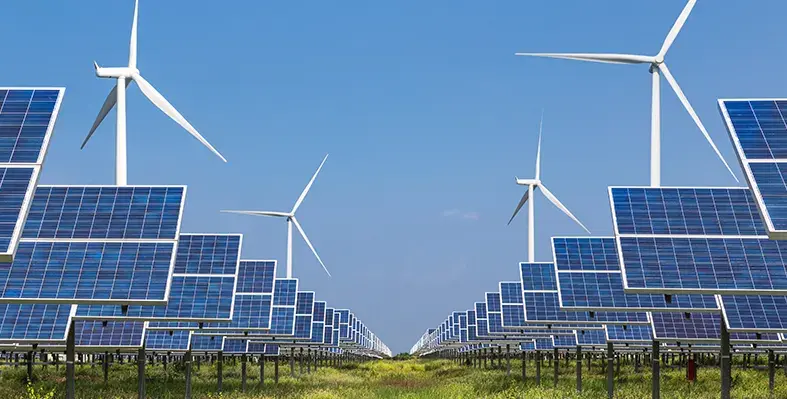
MENA solar wind power transition analysis