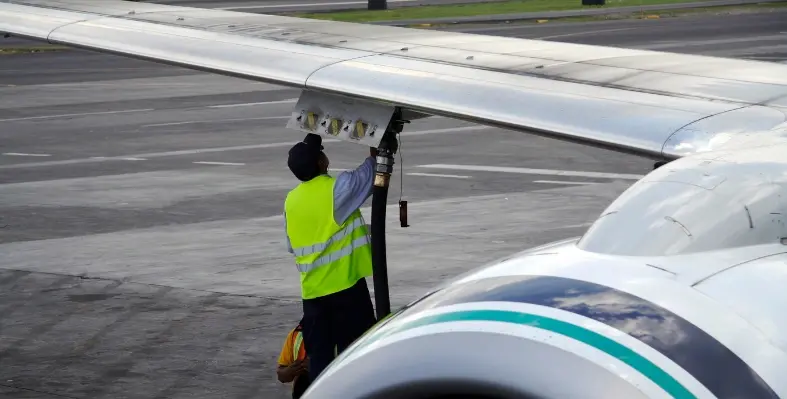
The Middle East and North Africa (MENA) region could emerge as a global leader in sustainable aviation fuel (SAF) production and trade, according to a new white paper examining the region’s feedstock, infrastructure and policy advantages.
While SAF production is currently concentrated in Europe and North America, the paper, published by the SAF MENA Congress, argues that MENA has a unique opportunity to scale both biobased and synthetic fuels at pace, driven by abundant renewable energy, established hydrocarbon infrastructure and strong domestic aviation demand.
A central pillar of this potential lies in synthetic SAF, produced via power-to-liquids (PtL) pathways using green hydrogen and captured carbon dioxide. The region benefits from some of the world’s highest solar irradiation levels and growing wind capacity, enabling access to low-cost renewable electricity. This, combined with large-scale electrolysers and emerging carbon capture infrastructure, positions Gulf states in particular as highly competitive producers of e-SAF.
Unlike many regions facing land constraints and grid congestion, MENA can deploy renewables at scale and co-locate projects with industrial hubs, export terminals and aviation infrastructure. The paper highlights that existing refining, storage and pipeline assets can be repurposed for SAF, reducing costs and shortening project timelines.
The report also challenges assumptions that the region lacks viable biobased feedstocks. Urban waste, used cooking oil, animal fats and agricultural residues are identified as underutilised resources, particularly in Egypt and Turkey. In addition, desert-adapted biomass such as algae, halophytes and wastewater-grown crops could provide non-competitive feedstock options suited to arid climates.
Geography is another strategic advantage. Situated at the crossroads of Europe, Asia and Africa, MENA already hosts some of the world’s busiest aviation hubs. Short shipping distances, established fuel trading ecosystems and high volumes of long-haul refuelling make the region well placed to become a global SAF bunkering and export centre as international mandates tighten.
Policy alignment and access to sovereign capital further strengthen the region’s position. Several governments have adopted net-zero targets, hydrogen strategies and state-backed aviation offtake, creating conditions for large-scale investment and accelerated deployment.
The white paper concludes that SAF leadership will be determined not by technology alone, but by scale, cost and speed. With rising global demand and regulatory pressure, the question is no longer whether MENA can play a major role in aviation decarbonisation, but how quickly it chooses to do so.
MENA set to lead global sustainable aviation fuel market