As the global aviation industry faces mounting pressure to reduce its carbon footprint, synthetic sustainable aviation fuel (e-SAF) is rapidly emerging as a critical pathway to decarbonisation.
Manufactured using a combination of renewable electricity, hydrogen, and captured carbon dioxide, e-SAF offers a viable alternative to traditional fossil fuels. With new fuel requirements in the UK and Europe set to drive up demand for clean alternatives, the market for e-SAF is on the cusp of significant expansion over the coming years.
Recognising this shift, major energy players are positioning themselves to meet future supply needs. Against the backdrop of the ADIPEC 2026 conference, a strategic collaboration agreement was signed on 3 November 2026 to explore large-scale e-SAF production. The Abu Dhabi Department of Energy (DoE) has partnered with Evolve Fuels AG, a Swiss-based company operating under the Smartenergy Group, to evaluate the Emirate’s potential as a global hub for synthetic aviation fuels.
Core pillars of the strategic collaboration
The partnership will leverage Abu Dhabi’s vast renewable energy resources, alongside its established capabilities in hydrogen and carbon capture, to assess the technical and commercial feasibility of local e-SAF production.
To facilitate this transition, the agreement is structured around three primary areas of cooperation:
Connecting investors: Linking potential partners and investors in Abu Dhabi with Evolve Fuels’ expansive international project pipeline.
Regulatory frameworks: Supporting the development of robust policy and regulatory environments necessary to foster an e-SAF industry.
Strategic roadmapping: Designing a comprehensive strategy and roadmap for the eventual production of synthetic fuels within the Emirate.
A newly established joint steering committee will oversee these initiatives, assessing infrastructure demands, necessary technology transfers, and the development of local workforce capabilities. This phase will also involve identifying future industry partners and aligning prospective production facilities with actual market demand.
Aligning vision with market demand
For Abu Dhabi, the initiative represents a prime opportunity to diversify its industrial development and attract international investment. Established in 2018, the DoE is focused on transforming the Emirate’s energy sector through sustainable technologies while establishing a prosperous, low-carbon economy.
H.E. Abdulaziz Mohammed Al Obaidli, Director General of Regulatory Affairs at the Abu Dhabi Department of Energy, highlighted the importance of laying solid groundwork: “Sustainable aviation fuel has the potential to play an important role in the future of aviation. This agreement gives us an opportunity to assess how Abu Dhabi’s energy resources and industrial capabilities can support the development of this market, while creating opportunities for investment and technology partnerships. Our focus is on building the right regulatory and commercial foundations, so that any future projects are competitive, practical and able to deliver long-term value.”
Evolve Fuels functions as an investment platform designed to aggregate and accelerate renewable fuels of non-biological origin. Backed by Smartenergy—a firm founded in 2011 that specialises in green energy assets across the aviation, maritime, and data centre sectors—the company brings substantial market expertise to the region.
Horst H. Mahmoudi, CEO and Executive Chairman of Smartenergy, explained the strategic timing of the partnership: “Evolve Fuels is an investment platform that, starting in Europe, aggregates and accelerates e-SAF projects at a time when the market needs scale and speed. Through this agreement with the Department of Energy, we are opening our project pipeline to Abu Dhabi investors and partners, while jointly evaluating the potential for e-SAF production in Abu Dhabi, building on the Emirate’s renewable energy, PtX and carbon capture resources. Our goal is to position Abu Dhabi as a dominant global player in a market that is set to grow rapidly, as e-SAF quotas, starting in Europe and the UK, take effect.”
The next phase of development
Moving forward, collaborative efforts will focus on pinpointing priority opportunities and evaluating regulatory requirements. Any definitive investments or physical production facilities will be subject to subsequent, separate agreements. These future steps will depend heavily on further evaluations to guarantee that any new infrastructure aligns perfectly with long-term industrial priorities and remains commercially viable in a competitive global landscape.
Driving the future of sustainable aviation fuel
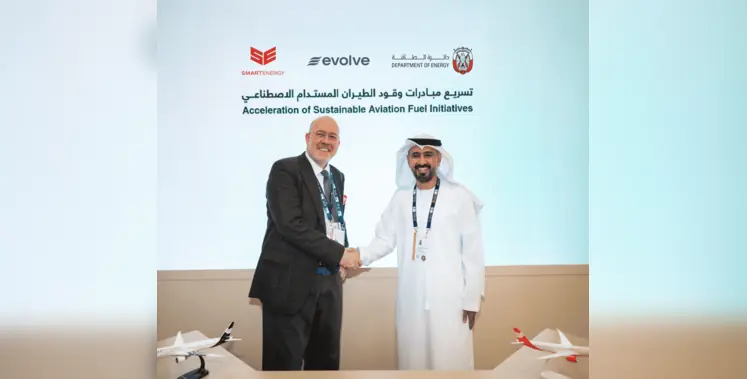
The Abu Dhabi Department of Energy (DoE) has partnered with Evolve Fuels AG, a Swiss-based company operating under the Smartenergy Group, to evaluate the Emirate’s potential as a global hub for synthetic aviation fuels.