The automotive industry faces critical hurdles surrounding energy efficiency, vehicle weight, and charging infrastructure, as the global transition toward electric mobility accelerates.
Historically, manufacturers addressed range anxiety by integrating increasingly larger battery packs. However, this approach inherently adds substantial weight, compromising overall driving efficiency. Today, the focus is shifting toward an alternative solution: advanced thermal management. By regulating heat generation more effectively, engineers can extract greater performance and faster charging capabilities from smaller, more compact battery systems.
Demonstrating the viability of this approach, Shell Lubricants showcased a highly specialised proof-of-concept vehicle at ADIPEC 2026 in Abu Dhabi. The showcase highlighted how next-generation fluid technologies can fundamentally alter the physics of electric vehicle (EV) charging, negating the need for oversized battery architectures.
Overcoming the charging bottleneck
Presented as the Triple 10 Challenge car, the concept vehicle serves as a working exploration into the future of electric mobility. Rather than equipping the vehicle with a cumbersome battery pack, engineering teams combined a compact energy storage system with pioneering thermal fluid technology. This architecture is designed specifically to manage heat distribution across the vehicle during high-stress operations.
The project was anchored around three defining ambitions:
Achieving a charging cycle from 10% to 80% in under 10 minutes.
Reaching a driving efficiency metric of 10 kilometres per kilowatt-hour (km/kWh).
Targeting a total lifecycle carbon footprint of approximately 10 tonnes of CO2 equivalent (CO2e).
During testing, the vehicle charged from 10% to 80% in just 9 minutes and 54 seconds. Notably, this was achieved using a standard 175 kW public charger, adding 24 kilometres of driving range for every minute plugged in. The design targets 10 km/kWh driving efficiency, representing an improvement of more than 30% compared with many current-generation electric vehicles.
Next-generation thermal fluid technology
At the core of this engineering breakthrough is the Shell Recharge Thermal Fluid. This specialised dielectric fluid facilitates a dual-cooling approach that manages thermal loads dynamically. It enables direct immersion cooling for battery cells, ensuring uniform temperature regulation, while providing indirect cooling for powertrain components, including the electric motor and power electronics. This supports a simplified cooling architecture, reducing the thermal stress typically caused by fast charging.
Addressing this development, Haytham Yehia, General Manager, Shell Lubricants Middle East, Egypt and Central Asia, stated: "The Shell Triple 10 Challenge concept car is a powerful example of how we're taking our expertise in advanced fluids beyond traditional lubrication. We're increasingly looking at how our technology can help customers address challenges around efficiency, performance and thermal management. For the Middle East, where we see growing opportunities across mobility, digital infrastructure and industrial applications, innovations like these demonstrate the value of combining Shell's global technology capabilities with strong regional partnerships."
Expanding cooling solutions across industries
The implications of sophisticated thermal management extend beyond the automotive sector. Alongside the concept car, the showcase featured comprehensive portfolios of coolants and immersion cooling solutions tailored for broader industrial demands. As global reliance on artificial intelligence and cloud computing intensifies, data centres and battery energy storage systems face unprecedented cooling requirements. Specialised fluids are becoming essential to maintain operational reliability.
Aysun Akik, Shell Lubricants’ Vice President of New Business Development and Global Key Accounts, highlighted this potential: "It's exciting to bring the Triple 10 Challenge concept car to ADIPEC and give visitors the opportunity to see the technology up close. What makes this concept so interesting is how much difference effective thermal management can make to EV performance. We've also had some great conversations with customers and partners about how advanced cooling technologies can support their own operations, and we're looking forward to building on those discussions beyond ADIPEC."
The exhibition coincided with the company marking 20 consecutive years as the world's number one finished lubricants supplier, according to Kline & Company's 2026, 24th Edition Global Lubricants Market Analysis and Assessment. Through ongoing technical innovation, advanced fluid capabilities continue to address changing requirements across mobility, energy, and digital infrastructure.
Rethinking EV efficiency with advanced thermal management
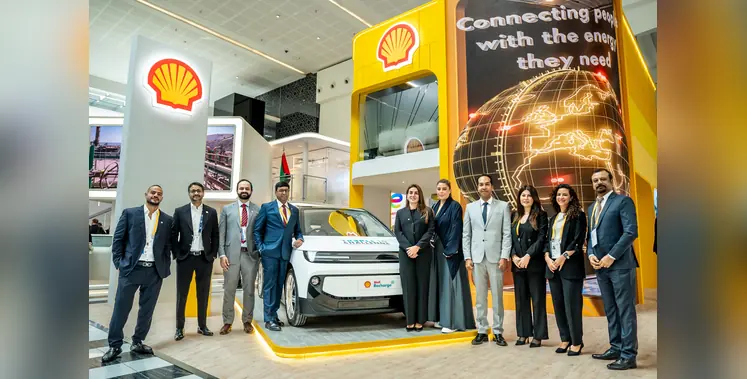
Shell Lubricants showcased a highly specialised proof-of-concept vehicle at ADIPEC 2026 in Abu Dhabi.