Industrial fire safety across the Gulf Cooperation Council (GCC) is shifting from reactive emergency response to proactive risk management.
Traditional fire detection technologies have long relied on identifying products of combustion, like smoke or flame, meaning a fire has already begun before an alarm triggers. In critical infrastructure, an abnormal temperature rise often provides the earliest indication of an emerging hazard. Addressing this, Teledyne FLIR has introduced the first thermal imaging cameras to achieve the ANSI/CAN/UL 2684 listing, providing an independently evaluated benchmark for thermal image fire detection to support resilient industrial operations.
Elevating Standards for Gulf Infrastructure
The recent UL 2684 listing of Teledyne FLIR's A40 and A70 (Axx-Series) models marks a watershed moment for fire engineers and asset owners. This aligns with the 2025 edition of NFPA 72, the National Fire Alarm and Signaling Code. Under Section 17.12, NFPA 72 includes a dedicated category requiring thermal image fire detection systems to be explicitly listed.
For the GCC, where established fire protection frameworks lean heavily on NFPA codes and UL-listed equipment, this establishes a clearer pathway for specifying early detection solutions. While this benchmark does not replace local Civil Defence approvals, it offers stakeholders objective, laboratory-tested equipment rather than relying solely on manufacturer claims. The standard sets strict requirements for environmental performance, durability, and fire testing.
Key Applications in Critical Assets
The relevance to Middle Eastern markets is driven by the rapid expansion of high-value infrastructure. Thermal imaging provides early warnings where equipment degradation can smoulder long before ignition. Crucial applications include:
- Data Centres: Identifying anomalies like a busbar joint heating whilst under load.
- Solar Installations: Detecting faults in rooftop arrays, specifically within DC connectors or inverters where conventional detectors are absent.
- Heavy Industry: Safeguarding continuous-process manufacturing and refining operations.
- Energy Storage: Monitoring battery energy storage systems and electrical utilities.
The Mechanics of Proactive Visualisation
Unlike standard cameras used merely for general visualisation, a calibrated thermal image fire detector continuously measures absolute temperatures across every pixel. Operators can establish measurement regions to monitor precise temperature differentials, absolute thresholds, and rates of temperature increase.
This capability is vital because industrial equipment naturally fluctuates in temperature. A transformer running warm during standard operations is not a fire condition; however, if that component begins climbing in temperature whilst its operational load is falling, it provides a crucial early warning.
By identifying thermal anomalies before smoke is generated, organisations can transition from crisis management to planned maintenance. Teams can isolate a battery module or tighten a loose connection before operations are disrupted. Axx-Series cameras enhance this by combining thermal detection with visible imaging, allowing operators to verify alarms swiftly. Analytics are processed on the camera, minimising reliance on external servers and enabling devices to initiate events directly through compatible control systems.
Pioneering early fire detection in gulf infrastructure
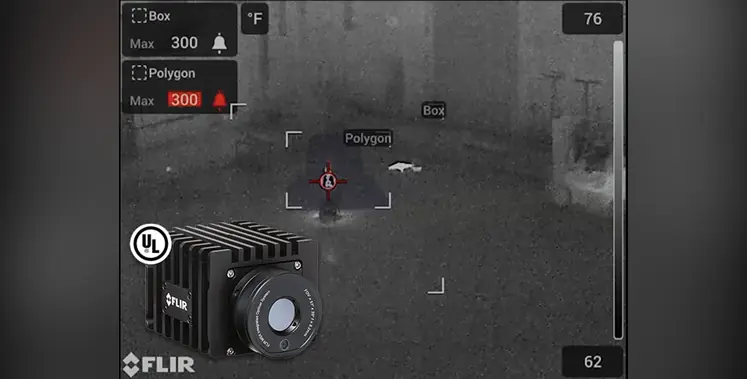
Teledyne FLIR has introduced the first thermal imaging cameras to achieve the ANSI/CAN/UL 2684 listing, providing an independently evaluated benchmark for thermal image fire detection to support resilient industrial operations.